Here information about the master of West-African classical percussion music : biography, concerts, recordings, ensemble performances, teaching, theoretical and practical courses, musical instruments, workshops, study travels to Guinea Conakry, development and children aid projects for Guinea Conakry — Contact to Mr. Alpha Oulare! *
Of course more* electronic or printed/scanned texts can be found than this one (by Kikoangoma — Danza y Musica Africana), mentioning Alpha Oulare & Sugé’sdebut album as musical reference for Guinean traditional Dances and Rhythms preserved; this ressource has been found by occasion recently… [Please click (what a word!) on the before currently red-colour hyperlinks!]
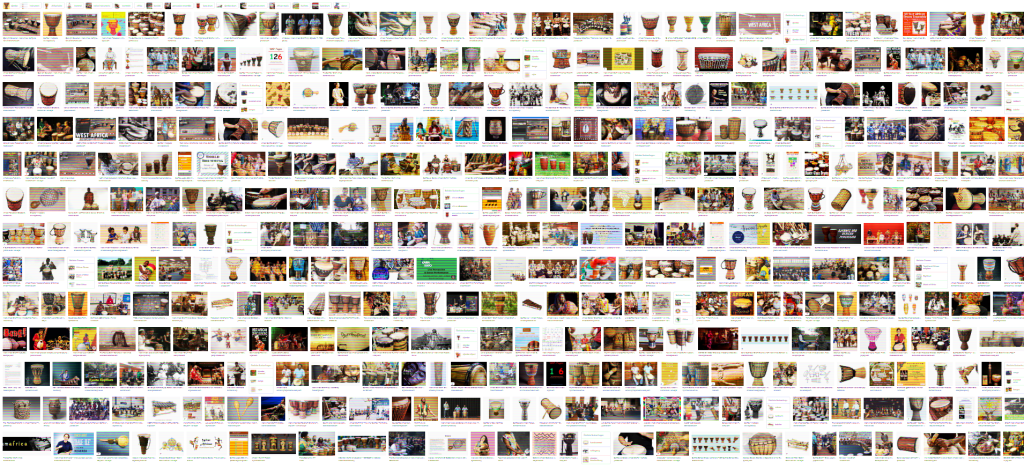
Technical issue: Using the Google Inc. Internet search
Postscriptum: * common sense (to some), that you also may try the Google Inc. Internet search to find similar Blog systems that provide information, here about West-African Percussion (click link!) — Many thanks to all contributors, all good wishes to them… (We feel links like these might be helpful to Internet readers/surfers, by this creating structures more toward a true Hypertext in global result).
(Another click above to find more images and their sources)
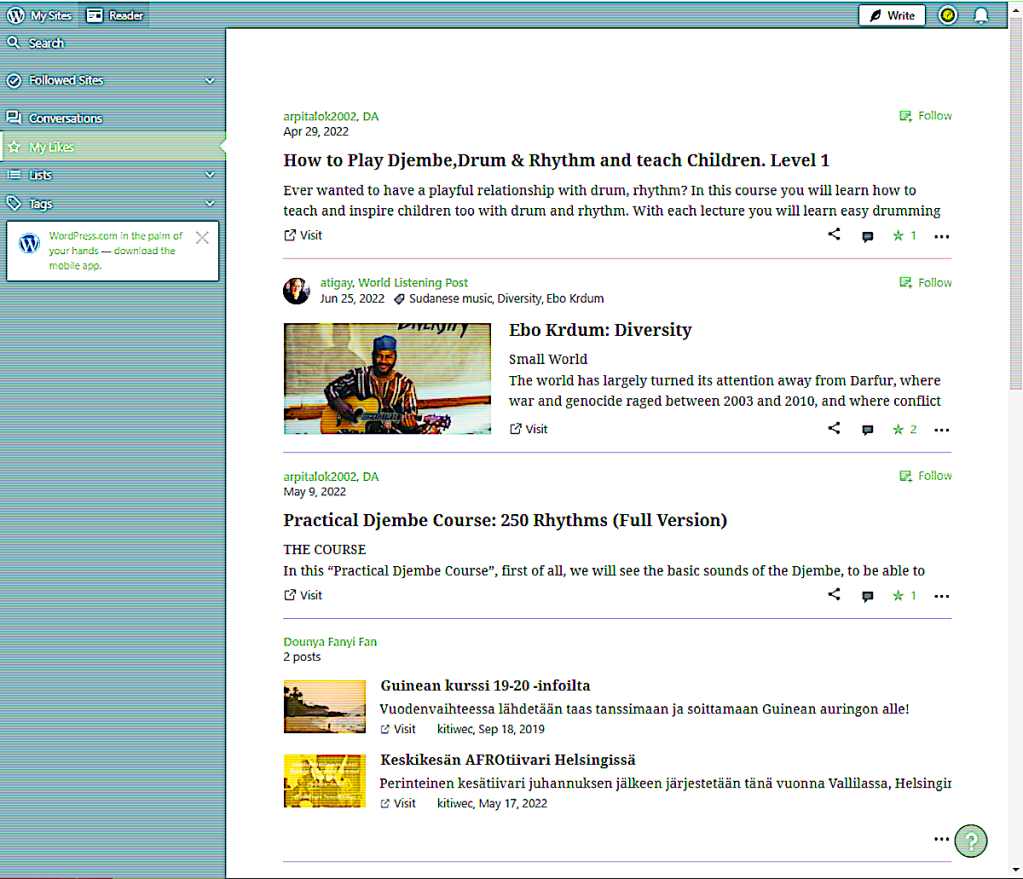
Side note: WordPress content management system (CMS)
(Surface of the WordPress Reader section)
Maybe consider also, to create an own WordPress account, or, to install as well the WordPress application also for mobile devices, this, even if it was only as reader of existing blogs, by this receiving the opportunity to submit comments, submit own searches, receive update/news notifications and more…
(Pardon us…)
*
As final contemplation watch / listen to Mamady Keïta (1950–2021): Rhythmes Traditionels di Mandingue (Traditional Mandinke Rhythms) (Beginner—Intermediate—Advanced) (200X)
We will often return to this authority, for he was one of Alpha Oulare’s important teachers and it appears to be both necessary and helpful to understand these influences of Alpha’s own music and musical teaching theory and practice.
{Mamady Keïta teaches Traditional DjembeBeginner Level. This video demonstration having been made »available to the general public so everyone searching to learn djembe from a true djembe master can have access to it. For more information about learning traditional djembe and dunun please visit [Mamady Keïta’s former] school’s website www.ttmda.com [Tam Tam Mandingue Djembé Academy]« (Mamady Keïta’s and heirs’ Google Inc. YouTube channel). May he rest in peace / may he not become forgotten! The tutorial contains these rhythms: Fankani (at 11’10”), Djabgbe (19’10”), Soli-rapide (26’50”), Kuku (33’25”), Mendiani (39’50”), Djaa (44’45”) and Moribayassa (at 50’30” — many thanks so to Alejandro S. for providing this first tracklist).} — You may try to download this video’s subtitles in several languages here.
[Mamady Keïta teaches Traditional Djembe Intermediate Level (same source: Mamady Keïta’s and his heirs’ official Google Inc. YouTube channel). Content: Background on the djembe, Greeting (at 3’11”), The instruments (4’26”); Kassa (5’30”): Dununs (5’58”), Djembé 1 and 2 (8’02”), Kassa ensemble (9’32”); Senefoli (11’50”): Dununs (12’19”), Djembé 1 and 2 (15’30”), Senefoli ensemble (16’27”); Sofa (18’35”): Dununs (19’10”), Djembé 1 and 2 (20’52”), Sofa ensemble (21’58”); Denadon (24’10”): Dununs (24’36”), Djembé 1 and 2 (26’09”), Denadon ensemble (27’04”); Djansa et solo (30’30”): Dununs (31’02”), Djembé 1 and 2 (33’08”), solo original (34’15”), Djansa ensemble (36’17”), Djansa solo (37’40”): Garangedon et solo (40’01”): Dununs (40’33”), Djembé 1 and 2 (42’19”), solo original (43’46”), Garangedon ensemble (45’30”), Garangedon solo (47’06”); Mendiani solo (49’20”): solo original (49’47”), Mendiani solo (51’30”); Soli-rapide solo (52’55”): Solo original (53’24”), Soli-rapide solo (55’28”); Farewell (at 57’06”) — thanks to Percussionworld for this more detailed track list.] — This video does not provide sub-titles.
[Mamady Keïta teaches Traditional Djembe Advanced Level (same source: Mamady Keïta’s and his heirs’ official Google Inc. YouTube channel). Content: Dunungbe (at 4’20”), Soliwoulen (10’40”), Tiriba (15’50”), Kalikambe (20’30”), N´goron (25’25”), Soko (31’40”), Koredjuga solo (36’30”) and Soboninkun (at 44’40”) — again thanks to Alejandro S. for providing a tracklist.] — Try to download the video’s subtitles here.
»We don’t just play the djembe to play a drum. We play the djembe to tell a story. Every rhythm has its story. It’s not enough to be technically good, but knowing the history of the rhythms you’re playing is very important. Where I come from, these stories are what we pass on from generation to generation. In the Manding tradition, we learn orally. We don’t write anything down. So we must memorize the rhythms and follow the way our Master teacher. A video can never replace a teacher. It is a tool to help students learn. It’s more of a key that helps students open the door to learning.«
THIS IN SHORT: We thank all new musical students and friends that joined Alpha Oulare’s Djembé lessons on this Saturday, August, the 20st, 2022, for the first time: what mighty sound yet, when playing together in group. Now about three female and four male drum students might hopefully attend the weekly two-hour lesson regularly — — yet having been announced, but not as yet concrete in time: this Autumn’s two-day weekend workshop later in the year… Students and all interested musicians shall receive the opportunity to learn and perform special own compositions by Alpha Oulare then. Might the event become sound-recorded?
*
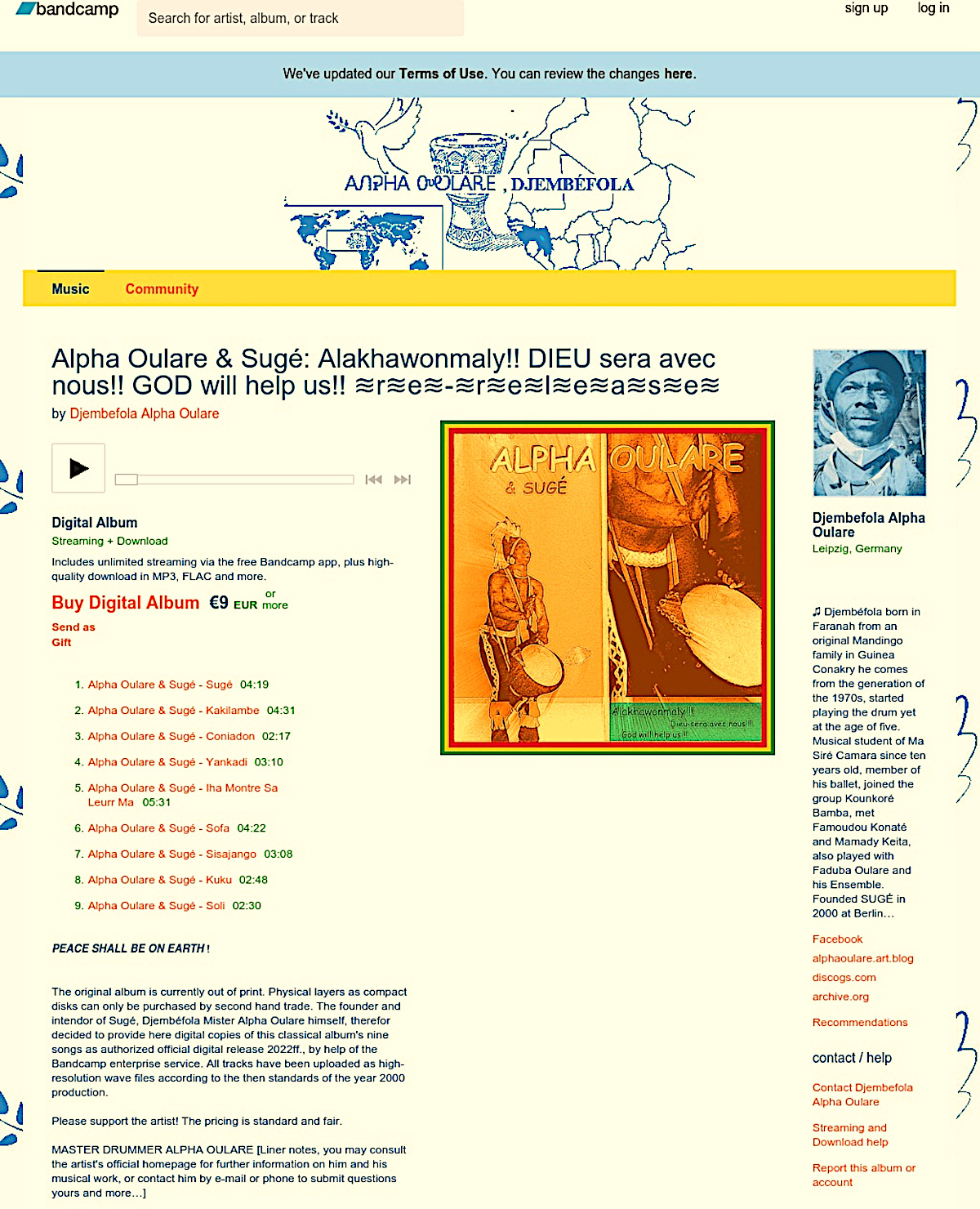
CLICK BELOW TO CONNECT TO THE BANDCAMP PORTAL OF ALPHA OULARE. You will find the before entrance prices for the year 2000 Sugé Album now reduced to common standard. The opening track SUGÉ offered here for only 80 euro-cents. / Page description and colours have changed…
*
Two Google Inc. YouTube videos from the Berlin Carneval of Cultures / Karneval der Kulturen 1996ff. (2007 and 2013)
(2007 Berlin Carneval of Cultures with drum players from Guinea)
(Six years later, in 2013, again drummers from Guinea)
Alpha Oulare himself … participated at the cultural festival in before years as member of La Fôret Sacrée, Konkobá, Sugé [links from Alpha’s newly updated Discographies profile] and as solo performer respective in free communion with other musicians and dancers, guests of the Carneval.
*
KONKOBA. By occasion another search at the SoundCloud music portal resulting in songs named Konkoba (embedding here at first Mamady Keïta, you should find also pieces by Tourmani Diabaté, Cissoko System and maybe more artists from West Africa and beyond):
»Liebe Freunde der afrikanischen Musik!!! Wir starten wieder durch und hoffen, ihr habt genauso viel Lust wie wir!!! Unter Beachtung der aktuellen Coronaregelungen können wir wieder unterrichten. Folgende Kurse bieten wir für euch an:
»Djembe für Erwachsene: Samstag 16–18 Uhr
»Afrotanz : Sonntag 15–17 Uhr
»NEU!!!! Djembe für Kinder: Sonntag 14–15 Uhr (ab 4 Jahre)
»Weitere Termine und Gruppen auf Anfrage!
»Ort: Ludwig-Hupfeldstr.16 / Leipzig
»Wer kann kommen? Alle die Spaß an westafrikanischen Rhythmen haben, diese gern erlernen möchten, sich auspowern oder einfach Freude am Musizieren verspüren möchten! Es ist für jeden was dabei: schaut vorbei und probiert es aus – wir freuen uns auf euch!« (Facebook, Mai 2021)
Without further annotations, but referring to international review and critics, we allow us here to include the truely enlightening documentary films by M. Laurent Chevalier »Djembefola« (1991) and »Mögöbalu« (1998) on the Guinean Master Drummer legend Mister Mamady Keïta (August 1950 – June 21st, 2021) — May he rest in Peace! In fact Alpha Oulare used to be student of Mamady Keita in his youth. We hope to be able by this reference to provoke deeper interest and understanding of these West-African Musical Arts and Culture as well as thanking Alpha Oulare’s former teacher Mister Mamady Keïta (The King).
FRENCH MUSIC DOCUMENTARY (translated subtitles available)
»I left my village Balandugu when I was 12 years old and returned after 26 years. This documentary was filmed when I make the trip back to Balandugu. I am sharinging it now with the world in hope that this inspires you and gives you the strength you need to continue your passion in this life.« (From the official Google Inc. YouTube channel° of Mamady Keïta and heirs — might he be remembered for long times…)
(° Postscriptum 19.10.2024: Google Inc. YouTube video references updated; now from two different sources, as the original Youtube film had disappeared / been removed(?). Please let us know future changes in this!)
MUSIC ALBUM: One by him is Mamady Keïta & Sewa Kan: Hakili (2011, BandCamp-distributed):
»To celebrate 50 years of his musical year, master percussionist Mamady Keïta embarked on a European tour with an expanded line-up his group Sewa Kan, adding balafon, kora and saxophone to the percussive core. The group played to tens of thousands across nine countries during summer 2009 and this CD and DVD provide an outstanding souvenir. The title Hakili, meaning good spirit, proves apt. Mamady’s career started when he was chosen, aged just 14, to join the newly formed National Ballet of Guinea — the major state-sponsored cultural troupe in the country. He went on to become Artistic Director and stayed with the Ballet for 20 years. He then moved to Belgium and formed Sewa Kan shortly after. His time is now spent teaching and playing from his new base in the USA. He has released nine albums with his group and several instructional DVDs. The CD (70 mins) was recorded during the tour; the DVD (100 mins) at the Jazz Sous Les Pommiers festival in France.
Musicians : – MAMADY KEÏTA : djembe solo, djembe bass, vocals & band leader – BABARA BANGOURA : djembe, backing vocals – SOULEYMANE “COBRA” CAMARA : djembe, kenkeni & kora – BABA TOURE : djembe, calabash, gongoma – MONETTE KEÏTA : kenkeni, djembe – CECE KOLY : sangban – YOUSSOUF TRAORE : dunumba – MAMA ADAMA CAMARA : dance & backing vocals – BEBEY YOULA : dance & lead vocals – KANDET DIOUBATE : dance & lead vocals – PRINCE DIABATE : kora & vocals – DJELIMADY KOUYATE : balafon – MANU HERMIA : flute & saxophone«.
(Annotation from the Discographies service, there more releases enlisted — please support the Artists!)
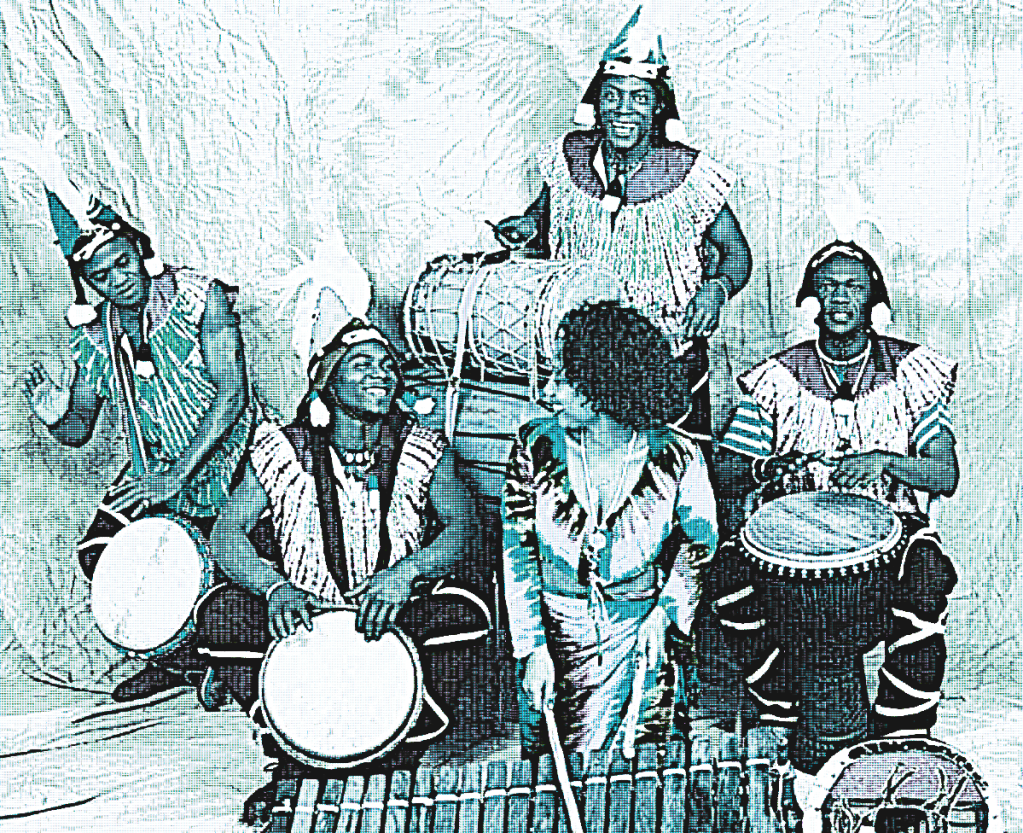
ᎪᏁᎮᎻᎪ ᏅᏬᏞᎪᎡᎬwas born in Faranah from an original Mandingo family in Guinea Conakry and comes from the generation of the seventies. He started playing drum at the age of five. He describes himself: »I saw the Djembé in a dream after I had left a cultural place where I had met Ma Siré Camara. I was ten years old and I said to him that I love the music, then he told, come with me … I studied with him for five years and soon became a member of his ballet. Afterwards I joined the group Kounkouré Bamba. At first, I accompanied and later became a solo Djembé player … I then met Famoudou Konaté and Mamady Keïta. We also played with Faduba Oulare and his Ensemble in numerous traditional festivals all over Guinea.«
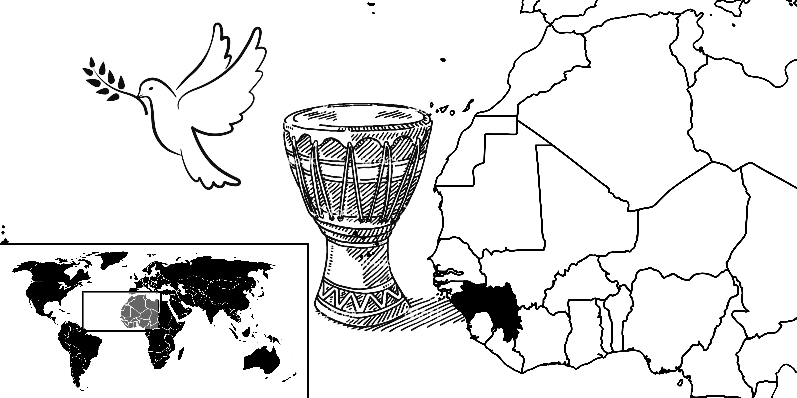
Peace shall be, the Djembé drum, West-Africa Guinea, Conakry, the World…
PUBLIC VISITOR COUNTER FOR THIS HOMEPAGE, BY REVOLVERMAPS.COM (click for details) since July 9th, 2022 — YOU ARE HERE :







 Djembéfola ALPHA OULARE / L'Institut Sunjata de famille de Monsieur Djembéfola Alpha Oulare, Guinea Conakry & Leipzig Europe (official homepages — pages d'accueil officielles — offizielle Internet-Seiten, 2022–2025ff.)
You must be logged in to post a comment.